
ICMA Centre PhD wins Teaching award for the 2nd year in a row

Dina Emma

Wenyi (Emma) Sun, has been selected by Reading University Students Union (RUSU) for the Graduate Teaching Assistant Excellence Award! This marks the second year in a row where a PhD Student from the ICMA Centre has won the award, with Dina Ghanma winning previously.
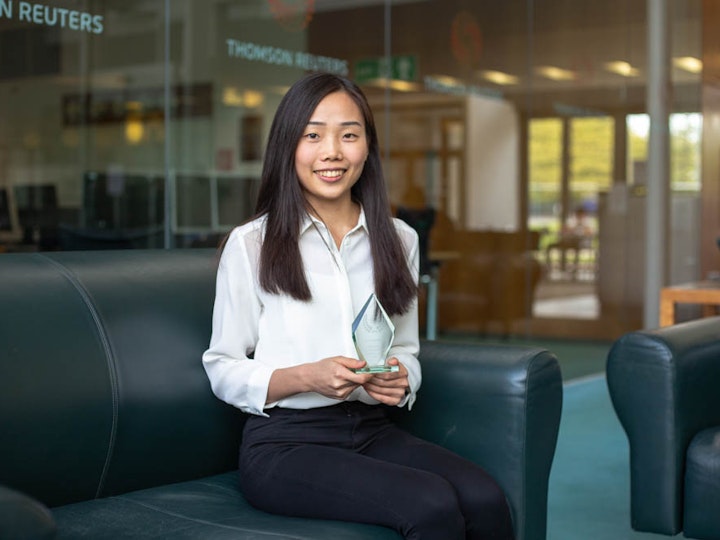
The award is part of the RUSU Excellence Awards, designed to recognise University of Reading staff who display excellent and innovative teaching practice. Students are invited to nominate staff who they believe have gone above and beyond expectations, tirelessly working to improve the delivery of their teaching and learning experience.

When asked about the award, Wenyi said "It is a great pleasure and honour to receive this award. I am very grateful that my work has been supported and recognised."

She went on to say "Teaching as an assistant is a wonderful part of my PhD journey - I truly enjoy spending time with my brilliant students. The aim of my teaching is to guide them on how to think pragmatically and to connect the knowledge from books to the real world".

Dina shared a similar view, saying "Winning RUSU’s teaching award last year was a truly humbling experience. Knowing that my students appreciated the effort I put into their seminars and reading everything they said in their nominations made me realise how much of an impact we can make on their education, even as PhD students"

Reflecting on the year since she won the award, Dina continued "This year, I taught two more modules, both of which were postgraduate. RUSU’s award definitely gave me a confidence boost for that challenge." She went on to congratulate to Wenyi for winning it this year, hopes the ICMA Centre PhDs can keep the streak going in the future!

Published 8 May 2018

You might also like

Professor Brian Scott-Quinn answers questions on the social value of high frequency traders on the FT.com

22 March 2010
Professor Brian Scott-Quinn, non-executive Chairman at the ICMA Centre, has been interviewed on the Financial Times.com 'Trading Room' webcast, tackling the question of 'Are high frequency traders socially useful' Professor Scott-Quinn also looks at the difficulty determining who owns a company's shares, due to high frequncy trading's quick turnovers.

Institutional investors, business and the public good from transactions to relations by Colin Melvin

13 January 2015
Colin joined Hermes Fund Managers in 2002 and became CEO of Hermes Equity Ownership Services in 2005. Colin provides advice and assistance to pension funds and other institutional investors in the areas of responsible asset management, corporate governance, voting and engagement. He is currently an Associate of the Centre for Corporate Governance Research of the University of Birmingham and a non-executive director of Aedas Europe, an architectural firm. Colin is currently an active member of various industry steering groups and committees including those of the United Nations Principles for Responsible Investment Initiative (for which he was the first Chair), Tomorrow’s Company Inquiry into Corporate Ownership, the Work Foundation Panel of Inquiry into Work and Enterprise, the Global Institutional Governance Network, the Institutional Investors Group on Climate Change and the International Corporate Governance Network. Previously, Colin was Corporate Governance Manager and Secretary to the Ethics Committee at Standard Life Investments and Head of Corporate Governance and responsible investment at Baillie Gifford.

New FinTech programme from September 2019!

12 November 2018
The ICMA Centre at the Henley Business School is launching an exciting new MSc in Finance and Financial Technology (FinTech). The first student intake will be in September 2019! FinTech products and services have transformed large sections of the finance industry, leading to new payment systems, financial planning tools, saving and investment platforms (for instance peer-to-peer lending solutions, crowdfunding, robo-advisory services and price-comparison web sites), algorithmic trading strategies and AI-based risk management tools (see EY Survey, 2017 and World Fintech Report 2018).